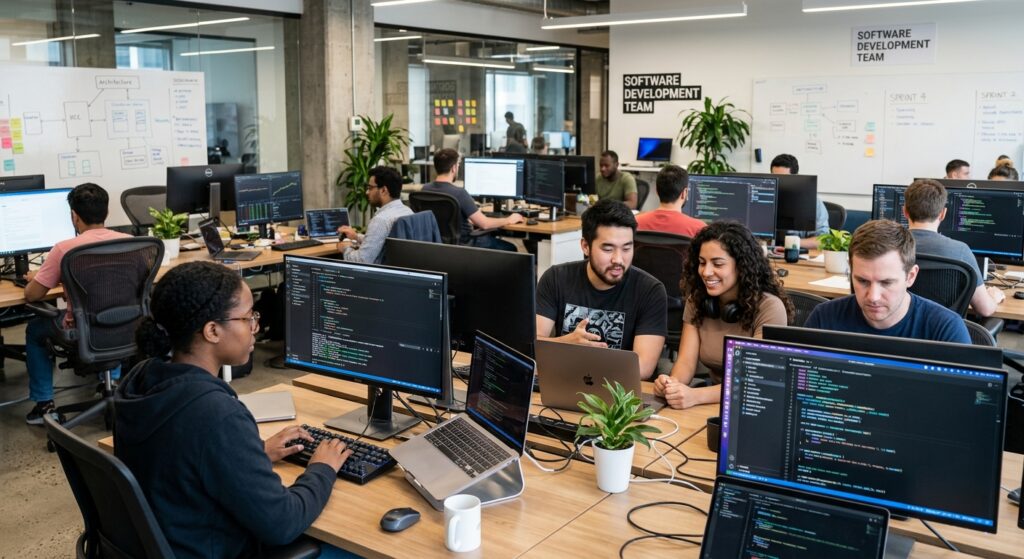

Software is used across websites, mobile applications, business systems, connected devices, financial services, manufacturing, and many other areas. Software developers are the professionals who design, build, test, modify, and maintain many of these systems.
For people interested in technology careers, Software Developer Jobs cover a wide range of responsibilities and technical specialties. Some developers focus on application interfaces, while others work with servers, databases, APIs, cloud technologies, or software architecture.
In the United States, the Bureau of Labor Statistics (BLS) projects employment of software developers to increase from about 1.72 million in 2025 to 1.89 million in 2035, representing 174,700 additional jobs and 10.2% growth. BLS also reports a median annual wage of $135,980 for software developers in May 2025. These statistics describe the U.S. labor market and should not be treated as worldwide figures.
What Are Software Developer Jobs?
A software developer researches, designs, develops, and modifies computer software. O*NET describes software developers as professionals who analyze user needs and develop software solutions using principles from computer science, engineering, and mathematics. They may also improve existing software and work with hardware or other software systems.
The exact responsibilities depend on the position. One developer may build customer-facing applications, while another may work on internal business systems, databases, APIs, or infrastructure-related software.
What Does a Software Developer Do?
Software development involves more than writing code. Developers may analyze requirements, design solutions, develop software, test applications, identify problems, modify existing systems, and communicate with other professionals.
BLS explains that software developers analyze users’ needs and design, develop, and test software to meet those needs. O*NET also identifies activities such as analyzing information, solving problems, making decisions, and working with computers as important parts of the occupation.
Common Responsibilities of Software Developer Jobs
Depending on the position, common responsibilities may include:
- Analyzing software requirements
- Designing software solutions
- Writing and modifying code
- Testing applications
- Finding and correcting software problems
- Improving existing systems
- Working with databases and APIs
- Documenting technical work
- Collaborating with other developers and professionals
Not every developer performs all of these tasks. Responsibilities depend on the employer, product, technology stack, and level of the position.
Where Do Software Developers Work?
Software developers work across multiple industries. BLS identifies computer systems design and related services, manufacturing, and software publishing among the major industries employing software developers. Developers can also work in organizations where software is an important part of another industry.
This variety means Software Developer Jobs are not limited to companies that sell software directly. A financial institution, manufacturer, healthcare organization, retailer, or other business may employ developers to create and maintain software systems.
Why Are Software Developer Jobs in Demand?

Growth of Software-Based Products
Software is increasingly incorporated into products and services. BLS specifically notes continued growth in software development for products such as consumer electronics, Internet-connected devices, and electric vehicles.
The U.S. employment projections also show continued growth for software developers. BLS projects 174,700 additional software developer jobs between 2025 and 2035.
AI, Automation, and Emerging Technologies
Artificial intelligence, robotics, the Internet of Things, and other automation applications are among the areas BLS identifies as supporting demand for software development.
This does not mean every software developer needs to specialize in AI. Instead, it shows that software development is involved in a broad range of emerging technologies.
Software Development Across Industries
Software is used across many sectors, creating opportunities for developers with different interests. A developer may work on financial software, manufacturing systems, business applications, consumer products, or other digital services.
The diversity of industries also means that developers can choose technical specialties based on the types of systems they want to build.
Cybersecurity and Connected Devices
BLS identifies increased investment in software designed to protect electronic networks and infrastructure as another factor supporting software development demand. The agency also points to the growing number of software-enabled products and connected devices.
These areas create development requirements involving applications, infrastructure, testing, and security-related software.
What Requirements Do You Need for Software Developer Jobs?
Education
For software developers in the United States, BLS lists a bachelor’s degree in computer and information technology or a related field as the typical entry-level education. Some employers prefer candidates with a master’s degree.
However, this should not be presented as a universal requirement for every employer or country. Hiring practices vary according to the organization, position, experience, and local market.
Programming Knowledge
Programming is a core part of Software Developer Jobs. The language required depends on the position and technology stack.
Current O*NET employer-posting data for U.S. software developer positions shows frequent mentions of Python, Java, SQL, JavaScript, C#, C++, and other technologies. For example, Python appeared in 29% of the analyzed postings, Java in 25%, SQL in 24%, and JavaScript in 20%.
These percentages come from U.S. job-posting data collected by Lightcast for 2025. They indicate how often a technology appeared in the analyzed postings; they do not mean that every software developer needs those technologies.
Practical Experience
Practical development experience can help candidates demonstrate their technical abilities. Experience may come from professional employment, internships, apprenticeships, academic projects, open-source work, or personal projects.
O*NET includes apprenticeship opportunities associated with software-development-related titles, including Application Developer and Software Developer.
Portfolio and Personal Projects
A portfolio can demonstrate how a candidate applies programming knowledge to practical problems. It can contain applications, websites, APIs, or other software projects.
A portfolio is not a universal requirement for every developer position, but it can be useful when candidates need to show practical work, particularly when professional experience is limited.
Internships and Training
Internships and structured training can provide exposure to professional development practices. Apprenticeships can also provide a practical route into some software development roles.
The value of training depends on the quality of the experience and how closely it matches the skills required by the positions a candidate wants to pursue.
Essential Skills for Software Developer Jobs
Programming and Problem Solving
Programming skills are necessary for writing and modifying software, but developers also need to understand the problems they are solving.
BLS identifies software developers as professionals who analyze users’ needs and design software to meet those needs. O*NET also identifies critical thinking and problem solving among important aspects of the occupation.
Database and SQL Knowledge
Many applications need to store, retrieve, and manage information. SQL is therefore relevant to many software development positions.
O*NET’s 2025 U.S. job-posting data shows SQL in 24% of analyzed software developer postings. Again, this percentage describes the dataset rather than a universal requirement.
APIs and Software Integration
Applications often need to communicate with other applications and services. APIs provide mechanisms for software systems to exchange information and functionality.
RESTful API appeared in 13% of the U.S. software developer job postings represented in O*NET’s 2025 data.
Understanding APIs can therefore be useful for developers working on connected applications.
Version Control With Git
Version control is an important part of modern development workflows. MDN describes version control systems as essential for backing up code, collaborating on codebases, and returning to earlier versions when necessary. Git is an example of a version control system.
Git appeared in 14% of the U.S. software developer postings represented in O*NET’s 2025 data.
Cloud and Development Tools
Cloud platforms and development tools also appear frequently in current software developer jobs postings. O*NET’s 2025 data lists AWS in 26% of analyzed postings and Azure in 19%. Kubernetes and Docker each appeared in 14% and 13%, respectively.
These figures should be viewed as indicators of employer demand in the analyzed U.S. job-posting dataset, not as a universal list of required technologies.
Communication and Teamwork
Software development is frequently collaborative. Developers may review code, discuss changes, work with other technical professionals, and communicate requirements or problems.
MDN explains that development teams commonly collaborate using version-control workflows, code reviews, comments, and shared repositories. O*NET also identifies communication with supervisors, peers, and other professionals as an important part of the occupation.
Types of Software Developer Jobs
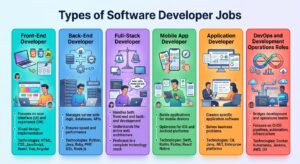
Front-End Developer
Front-end developers generally work on the parts of applications that users interact with directly. Web development can involve technologies such as HTML, CSS, JavaScript, and frameworks.
MDN’s web development curriculum includes HTML, CSS, JavaScript, accessibility, design, and version control among its core learning areas.
Back-End Developer
Back-end developers generally focus on server-side application logic, databases, APIs, and related systems. The exact responsibilities depend on the project and employer.
Full-Stack Developer
Full-stack developers generally work across front-end and back-end areas. A position may therefore require knowledge of user interfaces, server-side development, databases, APIs, and deployment.
Mobile App Developer
Mobile developers create applications for mobile platforms. The languages, frameworks, and development environments depend on the platform and project.
Application Developer
Application Developer is one of the job titles associated with the software developer occupation in ONET. ONET also lists titles such as Software Developer, Software Development Engineer, Software Engineer, Software Architect, DevOps Engineer, and Systems Engineer.
DevOps and Development Operations Roles
DevOps Engineer is another title listed by O*NET for the software developer occupation. The responsibilities of these positions can vary, but they may combine development work with deployment, infrastructure, automation, or operational responsibilities.
Software Developer vs. Software Engineer
Key Differences in Responsibilities
The distinction between software developer and software engineer is not identical across all employers. O*NET lists both Software Developer Jobs and Software Engineer among job titles associated with the same occupation.
Some organizations may use “engineer” for positions with broader system responsibilities, while another organization may use “developer” for similar work.
Where the Roles Overlap
Both roles can involve programming, software design, testing, maintenance, debugging, problem solving, and collaboration.
Because responsibilities overlap, candidates should focus on the actual job description instead of assuming that one title always represents a specific set of duties.
Why Job Titles Can Vary Between Employers
Technology companies do not necessarily use identical job-title systems. A Software Engineer at one company may perform responsibilities similar to a Software Developer at another.
Reading the listed responsibilities, technologies, qualifications, and experience requirements is therefore more useful than judging a position by its title alone.
How to Become a Software Developer
Learn Programming Fundamentals
Start with basic programming concepts such as variables, functions, conditions, loops, data structures, debugging, and basic software design.
Strong fundamentals make it easier to understand additional languages and frameworks later.
Choose a Programming Language
Choose a language that matches your learning objectives and target roles. Current U.S. job-posting data shows Python, Java, JavaScript, C#, and C++ among technologies appearing in software developer vacancies.
There is no need to learn every programming language at once. Building a solid foundation in one language can provide a practical starting point.
Learn Databases and Development Tools
After programming fundamentals, learn relevant databases, SQL, APIs, testing practices, version control, and development tools.
Git is particularly useful for managing source code and collaborating on projects. MDN describes version control as an essential part of modern coding workflows.
Build Real-World Projects
Projects allow learners to apply programming concepts to actual problems. Start with manageable applications and gradually increase their complexity.
For example, a project could include a database, API, user interface, authentication, testing, or Software Developer Jobs depending on the learner’s level.
Create a Portfolio
A portfolio can show employers what you have actually built. Include a small number of well-documented projects rather than filling the portfolio with unfinished experiments. Explain the purpose of each project, the technologies used, and the role you personally played.
Gain Practical Experience
Internships, apprenticeships, academic projects, open-source contributions, freelance work, and personal projects can all provide different types of practical experience. The most valuable experience is relevant to the kind of developer position you want to obtain.
Prepare for Technical Interviews
Technical interviews vary by employer. Preparation may include programming exercises, debugging, databases, software design, and questions about previous projects.
Being able to explain your approach is important because development work involves analyzing problems and communicating technical decisions.
Software Developer Jobs for Beginners
Entry-Level Software Developer Jobs
Entry-level positions can provide a starting point for candidates with limited professional experience. Employers may evaluate programming fundamentals, education, projects, internships, and other evidence of technical ability.
Junior Developer Positions
Junior developers generally have less professional experience and may work with guidance from more experienced developers. The exact responsibilities vary between companies.
Internships and Apprenticeships
Internships can provide exposure to professional development environments. Apprenticeships can provide structured training and practical experience, and O*NET identifies software development-related apprenticeship titles.
Building Experience Without a Previous Developer Job
Candidates without professional development experience can demonstrate their abilities through personal projects, academic work, open-source contributions, and other practical activities.
A candidate who has not held a developer job can still show what they know by presenting completed projects and explaining the technical decisions behind them.
How to Demonstrate Skills as a Beginner
Instead of simply listing “Python” or “JavaScript” on a resume, show how you used the technology.
For example, a project description can explain what the application does, what problem it solves, which technologies were used, and what features you implemented.
Software Developer Jobs Salary
What Is the Average Software Developer Salary?
For accuracy, it is better to use median annual wage when referring to BLS data rather than calling the figure an average.
BLS reports that the median annual wage for U.S. software developers was $135,980 in May 2025. The lowest 10% earned less than $82,460, while the highest 10% earned more than $214,670.
Factors That Affect Developer Pay
Developer compensation can vary according to location, industry, experience, employer, responsibilities, and other employment conditions.
BLS reported different median wages across major industries in May 2025. Software developers in software publishing had a median wage of $164,550, compared with $136,330 in manufacturing and $132,050 in computer systems design and related services.
Salary by Experience
Experience can affect compensation, but there is no single salary progression that applies to every developer.
A junior developer, mid-level developer, and senior developer can have substantially different responsibilities, but their actual compensation also depends on the employer and location.
Salary by Industry
Industry is one measurable factor in U.S. developer pay. BLS’s May 2025 data shows different median wages across major industries employing software developers. Software Developer Jobs one reason salary comparisons should identify both the country and industry.
Salary by Location
Location can also affect pay. U.S. BLS figures are specific to the American labor market, so they should not be presented as a global salary standard.
For international readers, local salary sources are more appropriate when comparing developer compensation in a particular country.
Remote and On-Site Compensation
Remote and on-site positions can have different compensation arrangements. Pay can depend on where the employer is based, where the employee works, the role, and the company’s compensation policy.
Candidates should therefore check the specific terms of each vacancy rather than assuming remote work automatically means higher or lower compensation.
Software Developer Career Path
Junior Software Developer
A junior developer typically focuses on developing professional experience, understanding team workflows, improving coding practices, and completing assigned development tasks.
Software Developer
As developers gain experience, they may take responsibility for larger features, applications, technical problems, and project components.
Senior Software Developer
Senior developers generally work on more complex technical problems and may provide guidance to other developers. The precise responsibilities depend on the organization.
Software Architect and Technical Leadership
Software Architect is one of the titles listed by O*NET for the software developer occupation. Experienced developers may also move toward technical leadership or other specialized roles.
Management and Other Advancement Options
Some developers move into engineering management, while others remain on a technical path. Possible directions depend on the individual’s interests and the opportunities available within an organization.
Where to Find Software Developer Jobs
Company Career Pages
Company career pages are useful sources for vacancies because they provide the employer’s own job description and application instructions.
Online Job Boards
Job boards can help candidates search by title, technology, experience level, and location. A targeted search can be more useful than searching only for the broad phrase “software developer.”
Professional Networking
Professional networking can help developers connect with recruiters, engineers, companies, and other technology professionals.
Developer Communities
Developer communities can provide opportunities to learn, collaborate, discuss technical problems, and share projects.
MDN notes that publishing work and participating in communities such as open-source projects can help developers collaborate and receive feedback.
Remote Job Opportunities
Some software development positions are remote. However, remote availability depends on the employer, position, country, and other employment conditions.
Freelance and Contract Work
Some developers work on freelance or contract assignments instead of permanent employment. These arrangements can provide different project experiences but may also involve different payment and employment terms.
How to Get Software Developer Jobs
Build a Strong Resume
A developer resume should clearly present relevant education, technical skills, projects, internships, and professional experience. Avoid listing technologies that you cannot discuss or demonstrate.
Create a Professional Portfolio
A portfolio should make it easy for an employer to understand what you built. Include project descriptions, technologies, screenshots or demonstrations where appropriate, and links to source code when it can be shared.
Showcase Relevant Projects
Choose projects that relate to the position. For a backend role, for example, a project demonstrating APIs and databases may be more relevant than an unrelated design-only project.
Prepare for Coding Interviews
Practice programming problems and review core concepts. Also practice explaining your reasoning because software development requires both technical work and communication.
Customize Applications
Read the complete job description and highlight skills that genuinely match the employer’s requirements. Customization should improve relevance without exaggerating experience.
Continue Developing Your Skills
Technology changes over time. O*NET’s current U.S. job-posting data includes programming languages, cloud platforms, databases, container technologies, APIs, version control, and frameworks among technologies appearing in software developer vacancies.
Future of Software Developer Jobs

How AI Is Changing Software Development
AI is an important area within current software development. BLS specifically identifies continued development of software for artificial intelligence among factors supporting demand for software developers.
The effect of AI tools on individual developer workflows can vary by employer, project, and role. Developers should therefore focus on understanding both software fundamentals and the tools relevant to their work.
Growing Importance of Cloud Technologies
Cloud technologies are visible in current employer demand. O*NET’s 2025 U.S. job-posting data lists AWS in 26% of analyzed software developer postings and Azure in 19%.
This does not mean every developer needs both platforms. The appropriate cloud skills depend on the target position.
Demand for Security-Focused Development
BLS identifies increasing investment in software that protects electronic networks and infrastructure as another factor supporting developer demand.
Security knowledge can therefore be relevant to developers working on applications and systems where protection of data and infrastructure is important.
Emerging Development Tools and Frameworks
Software development tools continue to change. O*NET’s current employer-posting data includes Kubernetes, Docker, React, Terraform, Kafka, and other technologies among tools mentioned in U.S. software developer vacancies.
Developers do not need to learn every new technology. A stronger approach is to understand core concepts and then learn tools that are relevant to their target work.
Why Continuous Learning Matters
Software Developer Jobs is a field where technologies and practices change over time. Maintaining strong fundamentals while learning relevant tools can help developers adapt to changing project requirements.
Common Challenges in a Software Development Career
Keeping Up With New Technologies
Developers encounter new programming languages, frameworks, libraries, platforms, and tools throughout their careers.
Trying to learn everything is unnecessary. Developers can instead focus on technologies relevant to their work while maintaining strong fundamental knowledge.
Solving Complex Technical Problems
Problem solving is a central part of software development. O*NET identifies critical thinking, decision making, and problem solving among important characteristics and activities associated with the occupation.
Getting the First Developer Job
The first position can be difficult because candidates have limited professional experience. Projects, internships, apprenticeships, and other practical work can help demonstrate technical ability.
Preparing for Technical Interviews
Technical interviews may require programming exercises, problem solving, debugging, and discussion of previous projects. Preparation should therefore include both technical practice and communication.
Maintaining Long-Term Skills
A development career involves more than learning one programming language. Software Developer Jobs can strengthen their knowledge through programming, databases, version control, testing, software design, communication, and relevant platform technologies.
Read more: What Is Application Mobile Dualmedia? Features, Benefits, and Uses
Tips for Building a Successful Software Development Career
Keep Your Technical Skills Current
Review job descriptions in your target market to identify technologies and skills that employers currently mention.
O*NET’s employer-posting data can provide one source of information about technologies appearing in U.S. software developer vacancies.
Work on Real-World Projects
Build projects that solve clear problems. A completed application can demonstrate development ability more effectively than a long list of technologies without evidence of practical use.
Learn From Code Reviews and Team Projects
Collaborative development can expose developers to different approaches to software design and implementation.
MDN describes code review, shared repositories, comments, and version-control workflows as common methods for collaboration in development teams.
Develop Communication Skills
Software Developer Jobs regularly need to communicate with colleagues and other professionals. O*NET identifies communication with supervisors, peers, and other professionals as part of the occupation.
Build a Professional Network
Connecting with other developers can help you learn from different experiences, discover communities, and become aware of professional opportunities.
Track Your Career Progress
Set practical goals for technical skills, projects, experience, and responsibilities. Reviewing progress can help identify areas that need more attention.
Final Verdict
Software Developer Jobs cover a broad range of responsibilities, industries, technologies, and career paths. Developers can work on applications, software systems, databases, APIs, connected products, and other technology solutions.
Current U.S. labor-market data shows continued demand for the occupation. BLS projects 10.2% employment growth for software developers from 2025 to 2035, with employment increasing from about 1.72 million to 1.89 million. BLS also reports a $135,980 median annual wage in May 2025. The most appropriate path will depend on the person’s goals, skills, location, education, and preferred area of software development.
FAQs About Software Developer Jobs
What qualifications are needed for software developer jobs?
A bachelor’s degree is the typical U.S. entry-level education reported by BLS, although requirements vary by employer.
Can I become a software developer without a degree?
Requirements vary, and practical projects and relevant experience can help demonstrate technical skills.
What skills are needed for software developer jobs?
Key skills include programming, problem-solving, databases, APIs, version control, and communication.
How much do software developers earn?
The median annual wage for U.S. software developers was $135,980 in May 2025, according to BLS.
What are the different types of software developer jobs?
Common roles include front-end, back-end, full-stack, mobile, application, and DevOps-related positions.
Are software developer jobs available remotely?
Yes, some software development positions are remote, depending on the employer, role, and location.
How can beginners get their first software developer job?
Learn programming fundamentals, build projects, create a portfolio, gain practical experience, and apply for suitable entry-level roles.