

A business website should do more than make a company visible online. It should help people understand what the business offers, find the information they need, take important actions, and interact with the company without unnecessary difficulty.
For some businesses, a simple website builder can handle those requirements. For others, standard templates and pre-built features are not enough. A company may need a custom booking process, customer portal, product configuration tool, ecommerce workflow, internal dashboard, or connections with existing business software.
This is where custom web development services can become valuable. Custom web development allows a website or web application to be planned around specific business requirements instead of requiring every process to fit into a predefined template. It can provide greater control over functionality, user experience, integrations, performance, security, and future changes.
What Are Custom Web Development Services?
Custom web services involve creating a website or web application according to the specific requirements of a business, organization, or project. The work can include planning, user-interface design, front-end development, back-end development, database development, integrations, testing, deployment, security improvements, performance optimization, and ongoing maintenance.
The defining characteristic is not that everything is coded from scratch. Developers can still use established frameworks, libraries, content-management systems, APIs, and other proven technologies.
Understanding Custom Web Development
Custom web development begins with understanding what the website actually needs to do. Before development starts, a team may examine the company’s goals, target users, required features, existing software, content, data, security requirements, and expected future changes.
How Custom Websites Differ From Template-Based Websites
Template-based websites usually begin with an existing design and a collection of standard functions. The business then adds its content, branding, products, or services within those available options. This approach can be practical and affordable for many organizations.
When Businesses Need a Custom Website
A business may consider custom development when its website needs to handle requirements such as:
- Custom customer journeys
- Member or customer accounts
- Advanced booking systems
- Product configuration
- Complex forms
- Custom calculators
- Specialized search and filtering
- Ecommerce workflows
- Internal dashboards
- Business-specific reporting
- CRM or ERP integrations
- Inventory or payment integrations
- Personalized user experiences
The strongest reason to choose custom development is not simply wanting a unique-looking website.
Why Custom Web Development Matters for Business Growth

A website alone does not guarantee business growth. Growth depends on many factors, including the product or service, market demand, pricing, customer service, marketing, sales, and overall business strategy. What a well-developed website can do is support those activities.
Custom web development services can make important information easier to access, simplify customer interactions, connect business systems, improve website usability, and create digital processes that are easier to measure.
Aligning a Website With Business Goals
Every business website should have a purpose. For one company, the main goal may be generating leads. For another, custom web services may be selling products. A professional service business may want visitors to schedule consultations, while a membership organization may need account management and restricted content. Custom development makes it possible to build website functionality around those objectives.
Creating a Unique Digital Presence
A company’s website is one part of its public identity. A custom website can give a business more freedom over its visual identity, content structure, interactions, and customer journey. But uniqueness should not be confused with complexity.
A website does not become better simply because custom web development services contain unusual animations or complicated design elements. A useful website should still be understandable, accessible, responsive, and easy to navigate.
Supporting Changing Business Needs
Businesses rarely remain exactly the same. A company may introduce new services, expand its product range, add customer accounts, enter a new market, connect another business system, or change the way customers place orders. A website designed only around today’s requirements may become restrictive when those needs change. Custom development can provide more control over future modifications when the underlying architecture has been planned carefully.
How Custom Web Development Services Help Businesses Grow
The value of custom web development services comes from solving specific digital problems. A well-planned website can improve the way customers interact with a company, while its underlying systems can help employees manage information and business processes more effectively.
Improve User Experience
User experience is not simply about attractive design. Visitors should be able to understand the website, find relevant information, navigate between pages, and complete important actions without unnecessary confusion. A custom website can be designed around the actual tasks users need to complete.
Strengthen Brand Credibility
People often make judgments about a business based on its online presence. A website that contains clear information, consistent branding, understandable navigation, working functionality, and accurate contact details can present a more professional experience. Custom development can help a business control how those elements work together.
Increase Conversion Opportunities
A conversion is an action that matters to a business. Custom web development services might be a purchase, inquiry, booking, registration, subscription, quote request, or another valuable interaction. Custom development can help businesses design these actions around their particular customers.
For example, a company that sells products requiring configuration could create a product-selection process that guides customers through the options before they reach checkout.
Improve Website Performance
Website performance affects how quickly pages load, how responsive interactions feel, and how smoothly users can navigate a site. Custom development can provide greater control over code, scripts, assets, database operations, and other technical components. That control can help developers remove unnecessary functionality and optimize important parts of the website.
Modern performance measurement also looks beyond simple page-load time. Google’s Core Web Vitals include Largest Contentful Paint for loading performance, Interaction to Next Paint for responsiveness, and Cumulative Layout Shift for visual stability. Google recommends aiming for an LCP of 2.5 seconds or less, INP below 200 milliseconds, and CLS below 0.1 for a good user experience.
Support Business Scalability
As a business grows, its website may have to handle more products, users, transactions, content, data, or integrations. A custom application can be designed with those requirements in mind. For example, developers may structure databases and application components so that new features can be added without rebuilding the entire system. Scalability is not guaranteed simply because a website is custom. Custom web development services depend on the architecture and infrastructure used.
Connect Essential Business Tools
Businesses often rely on several digital systems at the same time. A company may use separate tools for customer management, accounting, inventory, payments, email marketing, scheduling, analytics, and support. A custom website can connect these systems when appropriate.
For example, a customer submitting a quote request could have the information transferred into a CRM rather than requiring an employee to manually copy the details. These integrations can help turn a website into an active part of the business operation rather than an isolated source of information.
Key Benefits of Custom Web Development Services
The benefits of custom development depend on the project, but several areas can become especially important for businesses with specialized requirements.
Mobile-Friendly and Responsive Experiences
People use websites on devices with different screen sizes and capabilities. A responsive website adapts its layout and content to different screen environments so users can interact with the site without needing a separate desktop-only experience.
Google’s search documentation also emphasizes mobile usability and mobile-first indexing, making custom web development services important for businesses to ensure that their mobile experience contains the important content and functionality users need.
Better Website Functionality
Standard websites often provide common features such as contact forms, basic pages, blogs, and product listings. Some businesses need more.
Custom functionality can include:
- Customer dashboards
- Advanced search
- Product configuration
- Booking systems
- Quote calculators
- Membership areas
- Custom reporting
- Personalized content
- Specialized forms
- Business workflow automation
The key is to build functionality that solves a genuine business or customer problem.
Greater Flexibility and Control
Custom development can provide greater control over how the website looks, works, stores information, communicates with other systems, and evolves over time. This can be particularly useful when the website is closely connected to business operations.
Instead of changing the business process to match the limitations of a standard template, developers can create functionality that better reflects the actual process.
Improved Security
Website security is an ongoing responsibility. Modern web applications can face risks involving authentication, access control, security configuration, software dependencies, data handling, injection, and other areas.
The OWASP Top 10:2025 identifies major web application security risks including broken access control, security misconfiguration, software supply chain failures, cryptographic failures, injection, insecure design, and authentication failures. Custom development allows security requirements to be considered during architecture, coding, testing, and deployment.
Easier Integration With Business Systems
When several systems need to exchange information, integration becomes an important consideration. A custom website can be designed to communicate with external services through APIs and other integration methods. For example, an ecommerce website may need to communicate with payment services, inventory systems, shipping platforms, and customer records. When those connections are designed properly, the website can become part of a larger digital workflow.
Custom Web Development vs. Website Builders
Custom Web Development Services choosing between custom development and a website builder should depend on the business’s requirements.
Differences in Flexibility and Features
Website builders are designed to simplify website creation. They can provide templates, visual editors, hosting, standard features, and integrations that allow businesses to create websites without building every component themselves.
This can be an excellent solution when the business has straightforward requirements. Custom development provides greater freedom when the website needs specialized functionality or unusual workflows. The question is not which option is universally better. The question is which option provides the functionality the business actually needs.
Differences in Scalability
Website builders can support many growing businesses, particularly when the platform continues to provide the features and integrations those businesses require. Problems can arise when a company’s requirements move beyond the platform’s available capabilities. Custom development can provide more control over architecture and future functionality, but custom web development services also requires more technical management.
Choosing the Right Approach for Your Business
A website builder may be suitable when:
- The website has straightforward requirements.
- Standard features are sufficient.
- The business wants to launch quickly.
- Technical resources are limited.
- The company does not need extensive customization.
Custom development may be appropriate when:
- The website requires specialized functionality.
- Several business systems must be integrated.
- The customer journey is unusual.
- The website is part of daily business operations.
- The company needs greater control over functionality.
- The website is expected to evolve into a more complex application.
Neither approach is automatically the correct choice.
How the Custom Web Development Process Works
A custom project normally involves several stages, although the exact process differs between development teams and project types.
Planning and Requirement Analysis
Planning establishes what the website needs to accomplish. The development team may examine:
- Business goals
- Target users
- Required features
- Content
- Technical requirements
- Existing software
- Integrations
- Security requirements
- Performance expectations
- Measurement requirements
Clear requirements can help prevent unnecessary features and reduce misunderstandings during development.
Website Design and Development
After requirements are established, the project moves into design and implementation. The design stage focuses on structure, navigation, visual presentation, and user interaction. Development then implements the website’s front-end and back-end functionality. Accessibility should be considered during design and development rather than left until the final stage.
Testing and Quality Assurance
Testing checks whether the website behaves as expected. Depending on the project, testing may cover:
- Forms
- Navigation
- User accounts
- Responsive layouts
- Browser compatibility
- Integrations
- Performance
- Accessibility
- Security
- Error handling
A website that looks correct in one browser on one device can still contain problems elsewhere.
Launch and Ongoing Maintenance
Launching the website is not the end of its lifecycle. Websites require ongoing attention because software dependencies change, security issues are discovered, browsers evolve, business requirements change, and new functionality may be required.
Regular maintenance can include software updates, security improvements, backups, performance monitoring, bug fixes, content updates, and feature development.
How to Choose the Right Custom Web Development Services
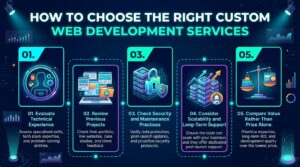
Choosing a development provider requires more than comparing prices.
Evaluate Technical Experience
Look for experience that matches the actual requirements of the project. If your website needs ecommerce, APIs, customer accounts, databases, or specialized integrations, ask the provider about previous experience with those technologies and workflows. A general claim that a company “builds websites” does not tell you whether custom web development services can handle your specific project.
Review Previous Projects
A portfolio can provide useful evidence of a development team’s capabilities. If possible, look at live projects rather than screenshots alone. Check whether the websites are easy to navigate, responsive, functional, and appropriate for their intended audiences. Also consider whether the examples demonstrate experience with projects of similar complexity.
Check Security and Maintenance Practices
Ask what happens after launch. Important questions include:
- How are security updates handled?
- Are backups provided?
- How are bugs addressed?
- Who monitors website performance?
- How are third-party integrations maintained?
- What support is available after launch?
Security should be treated as part of the development lifecycle rather than as a feature added at the very end. OWASP’s current Top 10 provides a recognized starting point for understanding common web application risks.
Consider Scalability and Long-Term Support
A website may need to change as the business grows. Before development begins, discuss how new features could be added later and how the existing system will be maintained. Also clarify who owns the source code, domain, hosting accounts, design files, and other important assets.
Compare Value Rather Than Price Alone
The lowest quote is not always the best choice. A development project should be evaluated according to its scope, functionality, security, quality, support, and long-term usefulness. At the same time, businesses should avoid paying for unnecessary complexity. The best proposal is usually the one that provides an appropriate technical solution for the actual requirements.
Common Mistakes to Avoid With Custom Web Development
Custom development provides flexibility, but poor planning can still lead to an ineffective website.
Focusing Only on Website Appearance
Visual design is important, but custom web development services are only one part of a successful website. A website also needs useful content, clear navigation, accessibility, reliable functionality, security, and good performance. An attractive interface cannot compensate for a confusing customer journey.
Ignoring Mobile Users
Mobile users should be considered from the beginning. Layouts, buttons, forms, navigation, images, and interactive elements all need to work appropriately on smaller screens. A mobile experience should not simply be a smaller version of the desktop experience. Custom web services should remain practical for the way people use mobile devices.
Overlooking Website Security
Security problems can affect both businesses and their users. Developers should consider authentication, authorization, input validation, secure data handling, dependency updates, server configuration, and other relevant controls.
Failing to Plan for Future Growth
A business does not need to build every future feature today. But custom web development services should avoid making unnecessary decisions that create obvious limitations later. Discussing expected growth during planning can help developers choose an architecture that is appropriate for both current requirements and realistic future changes.
Choosing a Developer Based Only on Cost
Price is important, but custom web development services should not be the only deciding factor. Technical experience, communication, testing, security practices, documentation, ownership, and ongoing support can all affect the long-term value of a project.
Read Also: 10 Best Linux Distro for Gaming in 2026: Performance, Features, and Compatibility
How to Measure the Success of a Custom Website
A website should be measured according to what the business wants custom web development services to accomplish.
Monitor Website Traffic
Traffic data can show how many people reach the website and where those visitors come from. Businesses can monitor metrics such as:
- Users
- Sessions
- Landing pages
- Traffic sources
- New and returning visitors
Track User Engagement
Engagement measurements can show how visitors interact with important website elements. Depending on the website, useful measurements may include:
- Button clicks
- Searches
- Form interactions
- Account registrations
- Product views
- Downloads
- Video interactions
- Content engagement
The most useful measurements are those connected to actual business goals.
Measure Conversions and Leads
Businesses should identify the actions that represent meaningful outcomes. These could include:
- Purchases
- Quote requests
- Bookings
- Contact submissions
- Account registrations
- Newsletter subscriptions
- Sales inquiries
Tracking these actions can help a company understand whether website visitors are moving toward meaningful outcomes.
Analyze Website Performance
Performance should be monitored after launch, not only during development. Core Web Vitals provide useful measurements for loading performance, responsiveness, and visual stability. Google’s recommended “good” thresholds include LCP of 2.5 seconds or less, INP below 200 milliseconds, and CLS below 0.1. Other performance factors can also matter, including server response time, image sizes, JavaScript usage, caching, and network conditions.
Evaluate Business Results
The final measurement should connect the website to the business. Ask questions such as:
- Are qualified leads increasing?
- Are customers completing important actions?
- Are online sales improving?
- Are users finding information more easily?
- Are employees spending less time on repetitive website-related tasks?
- Is the website supporting new business processes?
The answers will depend on the company’s goals.
Final Thoughts
A business website should be built around a purpose. For some companies, that purpose can be handled effectively by a website builder and standard features. For others, the website needs to perform tasks that require more control over functionality, data, integrations, and the customer experience. That is where custom web development services can make sense.
The real advantage of custom development is not simply having a website that looks different. It is the ability to create a digital system around the needs of the business and its users. A well-planned custom website can support specialized functionality, smoother customer journeys, business integrations, mobile experiences, performance improvements, security practices, and future development.
FAQs About Custom Web Development Services
What are custom web development services?
It creates websites or web applications based on specific business and user requirements. They may include design, development, databases, integrations, testing, security, performance optimization, and maintenance.
How can custom web development help a business grow?
Custom web development can support growth by creating digital experiences and features that match a business’s specific needs. Custom web development services can improve user journeys, support business processes, connect essential systems, and create clearer conversion opportunities.
Is custom web development better than using a website builder?
Not always, because website builders can work well for businesses with simple requirements and standard features. Custom development is more suitable when specialized functionality, complex workflows, integrations, or greater control are required.
How long does custom web development take?
The timeline depends on the project’s scope, functionality, design requirements, integrations, testing, and technical complexity. A simple website may take less time than a complex web application with accounts, databases, ecommerce, or multiple integrations.
How much do custom web development services cost?
The cost depends on factors such as functionality, design complexity, integrations, databases, security, testing, and ongoing maintenance. Because projects vary widely, businesses should compare development proposals based on scope, quality, support, and long-term value.